Inside Darrow’s Deceptive Pricing Radar
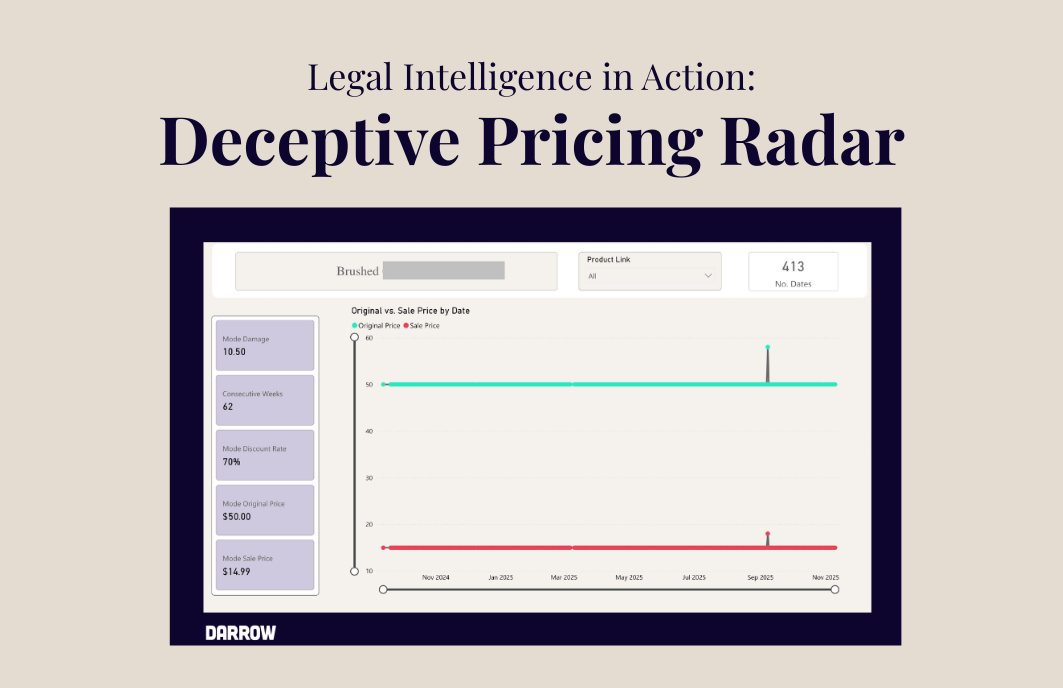
Darrow recently uncovered a deceptive pricing violation at a national ecommerce retailer where dozens of products were continuously advertised as “on sale,” despite never being offered at the referenced full price within the legally required period. An analysis of pricing behavior across the retailer’s catalog over several months preserved contemporaneous evidence showing that the purported discounts functioned as the regular selling price.
The conduct exposed the company to claims under multiple state consumer protection statutes, with modeled estimated damages of approximately $66 million affecting more than 400,000 consumers.
Violations like this rarely surface through manual research. Finding them requires sustained price monitoring and preserved evidence early enough to determine whether the conduct is actionable.
That is the gap Darrow’s Deceptive Pricing Radar is designed to address.
This article explains how Radar operates in practice to detect legal intelligence, from market-wide monitoring and violation detection through evidentiary preservation, viability analysis, and damages modeling, and shows how early detection gives plaintiff attorneys a more reliable foundation for pursuing class actions before evidence degrades.
Note: The Radar is an internal capability developed and operated by Darrow’s legal intelligence team to support violation discovery and evaluation. Every potential violation is reviewed and advanced by legal experts before a matter is ever shared with a partner attorney.
1. Monitoring the Market at Scale
The Radar continuously monitors pricing behavior across hundreds of high-traffic, high-revenue e-commerce website, with a focus on retailers where deceptive pricing practices can affect millions of consumers.
For each company, an automated network captures every sale page on the site and records prices over time. This creates a historical record of how products are priced, how long discounts remain in place, and whether advertised reference prices align with actual pricing behavior.
The Radar analyzes pricing histories to identify patterns that raise legal concern. Products advertised as “on sale” for more than 3 calendar months, for example, indicate that the reference price was never a genuine, prevailing price, which constitutes unlawful conduct under multiple consumer protection statutes across various U.S. states. Another example is when companies advertise a time-limited discount (what is known as "flash deals") but in practice it continues beyond the defined period (for example, beyond Black Friday or Cyber Monday or New Year's sales). Such conduct can also indicate false advertising by retailers.
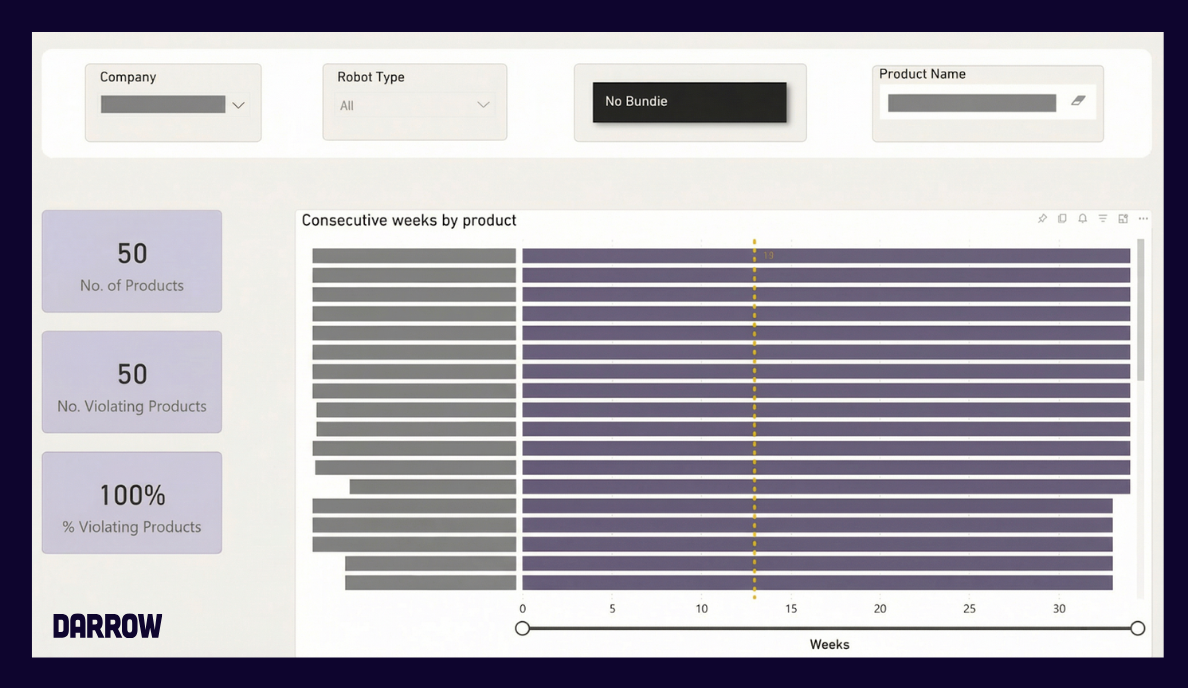
2. Violation Detection
Once the Radar identifies potentially concerning pricing behavior, the focus shifts to evidentiary preservation.
The tool preserves evidence from the outset rather than attempting to reconstruct it later so it can withstand scrutiny in court. With a single click, our team can view tabular data and daily screenshots of all products at a given company that were displayed with a fake discount over time.
Flagged leads are reviewed by Darrow’s legal intelligence team to confirm that the pricing behavior aligns with actionable legal theories, including how discounts are presented, whether reference prices are clearly defined, and how the pricing would likely be interpreted by a reasonable consumer.
%20(300%20x%20200%20px)%20(300%20x%20190%20px)%20(300%20x%20180%20px).png)
3. Assessing Case Viability
After a potential violation is confirmed, the analysis moves from detection to viability. Radar enables filtering based on factors that materially affect whether a case can proceed.
Legal intelligence analysts review both current and historical versions of a company’s terms of use, including versions that may predate the addition of arbitration clauses. In many cases, understanding when a clause was introduced can affect enforceability analysis and influence whether a class action remains viable.
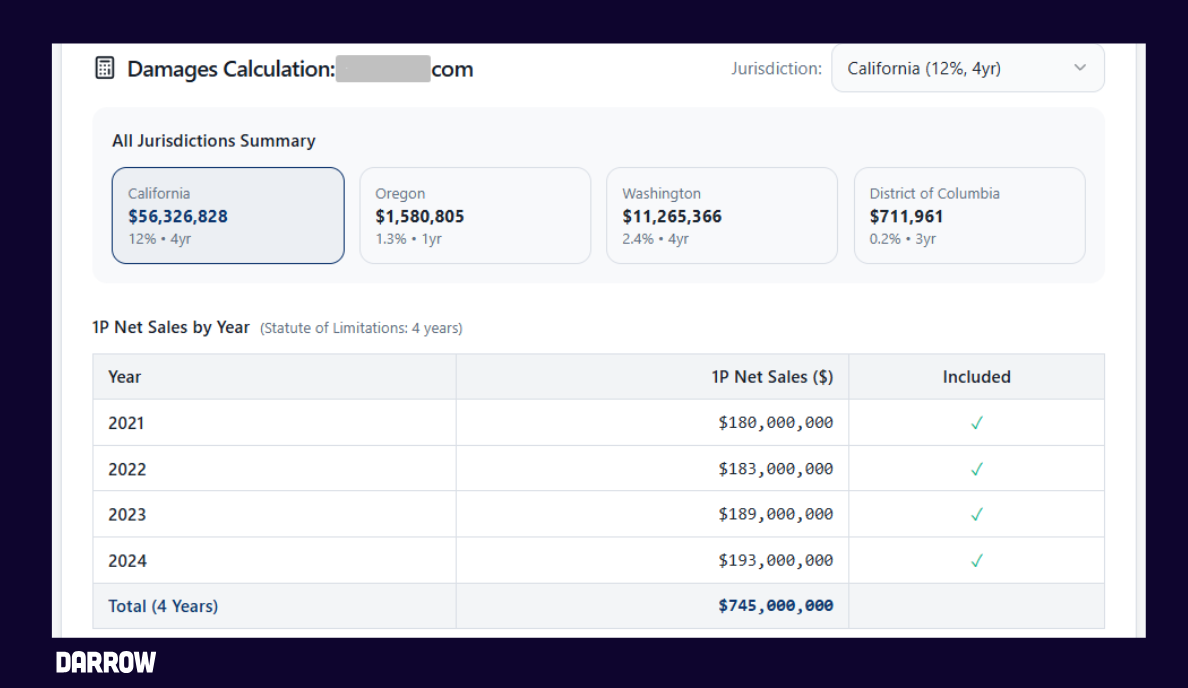
4. Quantifying Damages and Exposure
For matters that clear the viability threshold, the Radar supports detailed damages analysis.
These calculations inform strategic questions such as where to file, how many plaintiffs may be affected, and how damages may be framed. The outputs are transparent and traceable, allowing legal teams to understand how each assumption contributes to the final estimate.
.png)
5. Calculating Unique Victims
The Radar also displayed estimated number of consumers affected by a specific deceptive pricing practice. Using purchase data, pricing behavior, and industry benchmarks, the system models how many violating transactions occurred during the relevant period and how those transactions translate into unique victims.
These estimates are reviewed by Darrow’s legal experts to ensure alignment with realistic consumer behavior and litigation standards.
.png)
6. Litigation History and Risk Checks
Before a violation is advanced to a legal insight and shared with a Darrow partnering attorney, the Radar performs extensive checks for prior litigation by scanning public databases and legal news sources, including Top Class Actions, TINA.org. ClassActions.org, and Google News, to quickly identify whether similar deceptive pricing class actions have already been filed against the company. The second phase of the check goes deeper and includes searching through existing federal and state court dockets and documents to verify the information.
If prior actions are identified, the matter does not proceed. This step helps avoid duplication and reduces downstream litigation risk for Darrow and its partners.
Arbitration and jurisdiction analysis then examines arbitration provisions in a company’s terms of use, including their structure and potential enforceability, helping determine the most appropriate jurisdiction and potential firms best positioned to pursue the case.
.png)
From Intelligence to Legal Insights
For matters that pass all reviews, the Radar generates a case insight structured to mirror how courts and plaintiffs’ firms evaluate class action claims at the outset of litigation. It sets out the proposed causes of action, the statutory basis for liability, and the factual predicates supporting each element of the claim.
The insight assesses whether the observed conduct aligns with the requirements of applicable consumer protection statutes, including deception standards, materiality, and consumer reliance as interpreted by relevant case law. It also includes an evaluation ofwhether the alleged violations are susceptible to common proof.
%20(900%20x%20700%20px)%20(900%20x%20730%20px)%20(880%20x%20670%20px)%20(880%20x%20600%20px).png)
Each insight includes preserved evidentiary materials, damages modeling, victim estimates, and enforceability analysis. Class action viability is addressed through analysis of numerosity, commonality, predominance, and damages methodologies. Arbitration exposure, jurisdictional fit, and potential defenses are also included to ensure that the theory of the case is internally consistent and procedurally sound.
Before insights are shared externally, Darrow’s legal intelligence team reviews and refines them to confirm alignment across the legal theory, cause of action, and proposed class structure, to ensure the matter is positioned to proceed as a viable class action.
Judgment and Experience Remain Central
Darrow's deceptive pricing Radar supports early, court-aligned evaluation of potential class actions. At each stage, Darrow’s legal intelligence team applies legal judgment to assess whether the conduct, evidence, and damages theory can realistically support litigation, not merely whether a technical violation exists.
Offering a consistent pipeline of deceptive pricing matters supported by defensible data and legal analysis, Darrow partners with leading plaintiff firms across the country to identify, build, and litigate high-quality consumer protection cases.
This Might Interest You: