
NEXT ARTICLE
In 2025, we legal tech was all about efficiency gains. But moving into 2026, we’re going to see AI and legal tech solutions become more fully embedded into legal workflows. Agentic AI will start taking on defined tasks across research, drafting, and case management, operating within the systems lawyers already use and reducing the need to jump between tools.
How is AI Being Used in the Legal Industry?
The market size of global legal tech was estimated at $20.81 billion in 2025 and is expected to continue climbing at a rapid pace over the next 10 years. By 2034, the market is estimated to be valued at $65.51 billion.
According to a 2025 study by Thomson Reuters, among legal professionals currently using AI tools, the most common use cases include:
- Document review (77% of respondents)
- Legal research (74% of respondents)
- Document summary (74% of respondents)
- Brief or memo drafting (59% of respondents)
- Contract drafting (58% of respondents)
Catherine Kemnitz, Executive Vice President and Chief Strategy & Development Officer at Axiom Global, says:
"The gen AI wrecking ball is clearing the way for something new. Whether we like it or not, it’s coming for us all. Ensure your law firm or in-house team is prepared by running hard and smart to stay ahead of it, to shape it, and to transform it from an existential threat into a competitive weapon that amplifies your team’s capacity, efficiency, and impact."
Here are 8 common types of AI-powered legal tech tools:
- Legal research: Advanced AI can process extensive legal databases to locate relevant case law, statutes, and legal precedents. These tools help attorneys discover case law that might otherwise go unnoticed to develop stronger cases.
- Contract analysis tools: These tools review contracts to pinpoint risks, inconsistencies, and compliance issues. They assist attorneys by providing detailed evaluations of contractual terms, making the drafting and negotiation process more efficient.
- Predictive analytics: AI-powered data analysis examines historical case data to forecast potential outcomes, estimate settlement values, and assess case risks.
- Anomaly detection algorithms: Platforms like Darrow utilize AI to analyze databases and publicly available records for anomalies that may indicate legal violations.
- E-discovery software: This software streamlines the identification and categorization of electronically stored information, reducing manual effort and improving the accuracy of relevant document retrieval.
- Legal chatbots: AI chatbots manage routine client inquiries, provide legal information, and collect initial case details directly from a firm’s website, enhancing client engagement and streamlining intake.
- Document review and automation: Attorneys leverage AI tools with natural language processing to review and draft legal documents. These tools detect errors, highlight critical clauses, and automate repetitive tasks.
- Litigation management software: AI litigation platforms analyze case histories, court filings, and legal records to identify trends that inform case strategies. They assess factors such as judicial rulings and opposing counsel tactics to refine legal arguments and predict outcomes.
Now, let’s take a look at 10 of the best AI tools for lawyers on the market today.
%2520(2).png)
10 Best AI Tools for Lawyers
1. Darrow

Darrow is the leading Legal Intelligence solution for legal professionals to discover potential legal risk, assess the value of potential or ongoing claims, and take action faster. Darrow provides live insights on emerging risks, the evidence behind them, and provides attorneys with strong, viable legal opportunities. Darrow’s Legal Intelligence research team, a multidisciplinary group of web intelligence experts and attorneys with deep domain expertise in fields like finance, cyber security and environmental science, continuously develops the signals and methodologies that keep those insights current and actionable. The team conducts original investigations into emerging patterns of legal risk and translates its findings into scalable signals and methodologies that empower law firms to secure their next big opportunity.
Case Origination
Attorneys no longer need to spend weeks or even months investigating potential violations and case eligibility. The Darrow Platform allows them to quickly uncover legal violations and build cases by strong evidentiary support. Darrow’s proprietary AI technology and advanced anomaly detection algorithms sift through vast amounts of publicly available data to identify patterns that signal potential legal risks. Human analysts review every finding to ensure validity, and Darrow’s legal experts connect the dots, underwrite the case, and collaborate with plaintiff attorneys to develop compelling class action and mass tort lawsuits.
The in-house legal team provides strategic support as needed, giving partners access to expert insights, compelling evidence, and a solid legal foundation to maximize litigation success. This allows attorneys to spend less time on lengthy investigations and more time on strategy and case building.
Darrow also offers predictive underwriting services. Attorneys can bring their pipelines to Darrow for structured evaluation. Using AI, legal reasoning, and financial modeling to assess merit and likely outcomes, Darrow helps legal teams make the best decisions to manage portfolio performance.
Within the Darrow Platform attorneys can access:
- Signals: An AI-curated stream of emerging legal risks, filtered and scored from news, filings, and disclosures, helping legal teams spot potential violations before they become public knowledge.
- Snippets: A curated catalog of anonymized, litigation-ready case previews aligned to a firm’s practice areas and growth strategy. Each snippet highlights legal theory, harm type, jurisdiction, and potential damages.
- Case Memos: Structured legal briefs produced by Darrow’s case generation engine. Each Memo includes claims, evidence, jurisdiction, and projected damages, enabling attorneys to evaluate case viability with confidence and speed.
- Plaintiff Intake: A streamlined intake management tool that offers visibility into plaintiff qualification and coordination. Legal teams can track claimant progress, manage outreach, and ensure every case is matched with strong class representatives.

Plaintiff Services
Darrow also provides a plaintiff connection service, helping attorneys secure qualified, vetted plaintiffs with legal marketing while reducing the operational burden, costs, and risks involved in sourcing strong class representatives. The plaintiff services team collaborates closely with partner firms to develop compliant outreach strategies tailored to each case and firm priority.
From initial outreach through final qualification, Darrow manages the entire intake process and remains a dedicated partner throughout, ensuring every class is supported by high quality plaintiffs ready to move the case forward.
2. Lexis+ AI (LexisNexis)
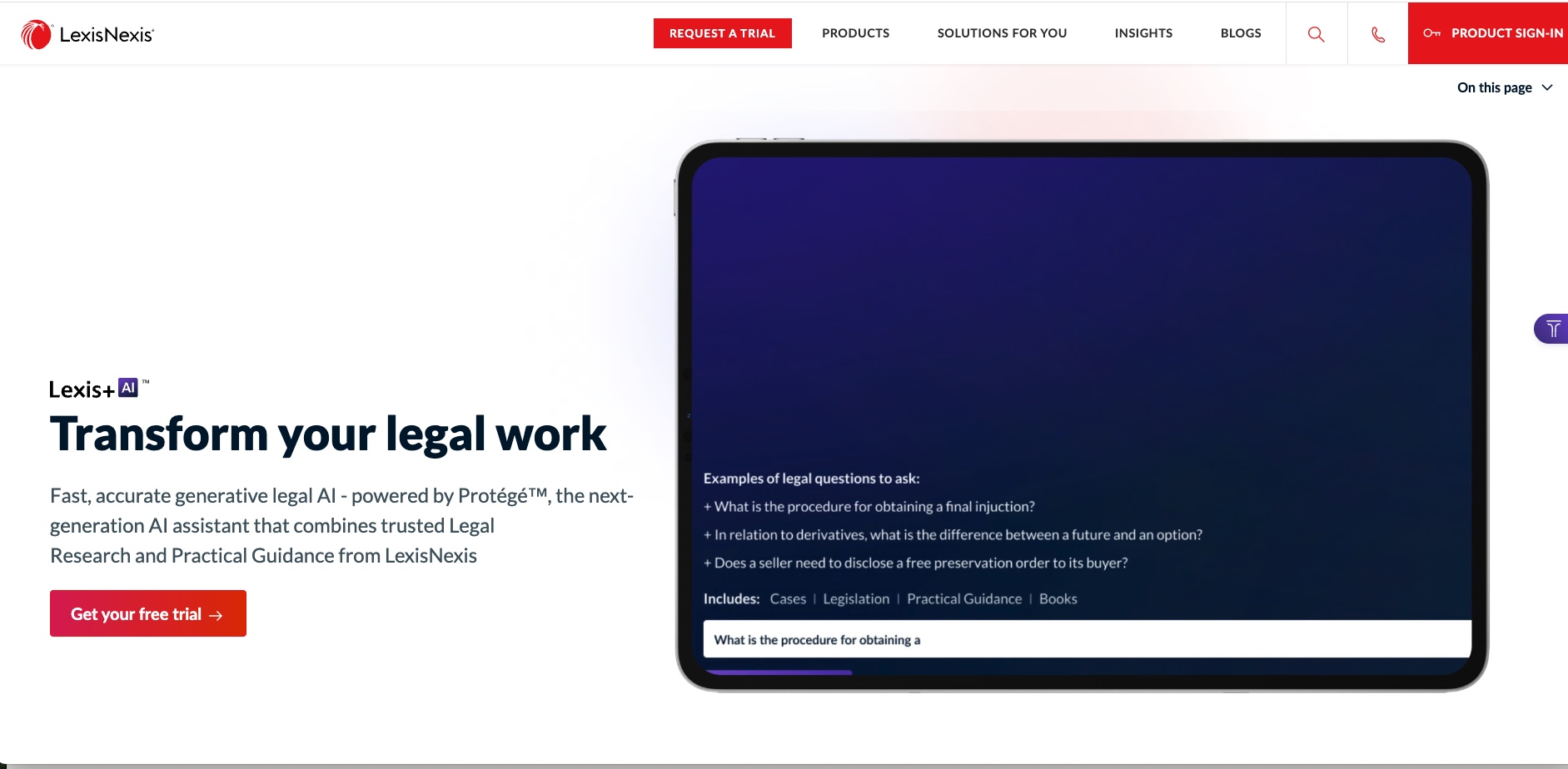
Lexis+ AI represents a quantum leap in legal research capabilities, combining LexisNexis's vast legal database with advanced AI functionality. The platform features an intuitive natural language interface that allows attorneys to pose complex legal questions and receive precise, contextually relevant answers.
Two standout features include the Brief Analysis tool and the Judicial Analytics feature.
The Brief Analysis tool reviews legal documents in minutes, identifies missing precedents, suggests additional relevant cases, and validates citations. The Judicial Analytics feature, which provides insights into judges' ruling patterns and preferences, helps lawyers craft more effective arguments.
Lexis+AI also offers an AI-powered document drafting assistant which helps attorneys generate legal documents while ensuring compliance with jurisdiction-specific requirements.
3. Harvey
Harvey continues to be a leading professional-class AI platform built for law firms, combining advanced language models with legal domain training to support research, contract analysis, drafting, and workflow automation. Recent product enhancements focus on integration with core legal systems and expanding how Harvey can fit into existing workstreams lawyers use daily, including integrations with practice management and billing tools via strategic partnerships with companies like Aderant. This means firms can connect legal insights more directly with operational and financial data while leveraging Harvey’s generative and analytical capabilities across matters.
4. Clio

Clio Manage AI, formerly Clio Duo, is now directly integrated into Clio Manage rather than as a separate add-on. Manage AI goes beyond drafting and summarization to automate routine practice tasks like extracting deadlines and turning them into actionable calendar items, generating invoices from activity, drafting client updates, and organizing matter files. Embedded within the Clio ecosystem, these capabilities help reduce administrative overhead and keep firms aligned to deadlines and workflows. The broader Clio platform recently secured a major funding round that will support future AI product development and expanded services.
5. Spellbook

Spellbook is intended for transactional lawyers and completely changes the contract drafting and review game with AI-powered legal document creation that works directly in Microsoft Word. This tool stands out for its ability to learn from a firm's existing contract templates and drafting preferences, creating a customized drafting experience.
It uses tailored legal AI to speed up drafting, redlining, clause suggestions, and risk detection. A recent expansion of its capabilities includes Spellbook Library, which lets the AI learn from a firm’s own precedent library to produce outputs that better reflect internal drafting conventions and stylistic preferences. This contextual learning can make contract work more consistent with firm standards.
6. NexLaw

This AI-based legal platform helps with multiple litigation tasks. NexLaw’s main feature, the AI Trial Copilot, works alongside attorneys during trials by quickly pulling up relevant case law, providing guidance on procedures, and suggesting possible objections when needed.
For legal research, the system includes an AI-powered search function that lets attorneys quickly find specific cases, statutes, and precedents. Instead of manually reviewing thousands of documents, they can search the database and get relevant results in a few seconds.
The platform can also analyze past case data and jurisdiction patterns to estimate likely outcomes for current cases. It includes a document organization tool that puts case materials in chronological order and points out where evidence might be missing. There's also a feature that examines witness statements and deposition transcripts to identify patterns that might indicate credibility issues.
7. MyCase

MyCase’s AI Document Automation streamlines legal document creation by filling in templates with case-specific details, reducing the time spent on repetitive tasks.
The platform also offers AI Insights, which examine case files, billing records, and client communications to identify trends and provide recommendations for improving client intake, productivity, and cash flow.
MyCase’s also offers an AI-powered time tracking tool, which simplifies the process of capturing billable hours and automatically logging time spent on activities like document drafting and email correspondence. The AI-driven email management feature is another particularly useful tool, which helps attorneys stay organized by categorizing and prioritizing client communications, making it easier to respond in a timely manner and maintain clear records.
8. Thomson Reuters CoCounsel

Thomson Reuters' CoCounsel is an AI-powered legal assistant designed to support attorneys with research, drafting, and document review. Built on Thomson Reuters' extensive legal research database, CoCounsel is capable of analyzing thousands of cases to identify relevant precedents and legal arguments. Its document review features help attorneys sift through discovery materials and flag key documents and potential privilege issues.
CoCounsel also assists with drafting legal memoranda by providing detailed analysis on legal issues. Additionally, the platform offers real-time updates on new cases and regulatory changes, allowing attorneys more easily remain informed about developments that affect their ongoing cases.
9. Paxton
.jpeg)
Paxton distinguishes itself as an AI-powered litigation support tool focused on evidence management and trial preparation. The platform's advanced document analysis capabilities can process multiple file types, from emails to social media posts, identifying relevant evidence and potential exhibits.
The unique timeline generation feature automatically creates visual representations of case events, making it easier to present complex narratives to judges and juries. Paxton's deposition analyzer can identify contradictions and inconsistencies across multiple testimonies, while its trial presentation mode offers real-time access to all case materials.
Paxton also includes AI-powered jury selection assistance by analyzing demographic data and historical verdict patterns.
10. IronClad

This contract management software automates the entire contracting process, from initial drafting to execution and renewal.
IronClad offers an intelligent workflow system that can route contracts to appropriate stakeholders based on content and risk level. It also offers an AI engine that flags potential issues and suggests improvements.
Another one of IronClad’s unique features is its ability to translate complex legal language into plain English for non-legal stakeholders. This can be particularly beneficial for contract negotiations and getting through the approval process when dealing with those unfamiliar with legal terminology.
The AI assistant is another useful tool, which automatically drafts initial contract templates using pre-approved clauses and adapts them to the specifics of each transaction, significantly reducing the time needed for manual drafting.
Will AI Replace Lawyers?
Haley Sylvester, Associate at Pryor Cashman, says:
“The legal profession, often characterized by a reverence for tradition and resistance to change, is at the cusp of a technological revolution that promises the potential to reshape the profession.”
In fact, AI adoption in law firms skyrocketed from 19% in 2023 to 79% in 2024, proving that even the legal industry has jumped on the AI-bandwagon.
Yet there is an underlying fear about technology making its way into the legal field. And understandably so. How can technology understand the nuances of the law and make delicate legal decisions?
AI is a formidable technology, and legal tech companies have trained AI models to complete all sorts of tasks, including scouring and sorting large datasets, drafting briefs, analyzing case law, learning from humans, and so much more.
But AI is not human. And these tasks are only half of a lawyer’s job.
The other half involves courting clients, maintaining relationships, strategizing complex cases, and making judgment calls rooted in empathy and ethics. The legal industry needs humans to foster trust and provide personal guidance and advocacy that no machine can replicate.
Sylvester explains:
“I am confident that the services I provide my clients cannot be replicated by an algorithm-powered chatbot; however, the services I provide – and the speed and cost at which I provide them – can certainly be improved by such a bot.”
So, not to worry. AI can streamline and speed up workflows, but AI cannot replace the human elements of lawyering, like empathy, strategic judgment, and the ability to build trust with clients. AI is a complement, not a competitor, empowering attorneys to focus on what they do best: advocate for their clients and fight for justice.
This Might Interest You:
