
NEXT ARTICLE
Multi-level marketing (MLM) companies sell a powerful promise: financial freedom, entrepreneurship, and independence. But in reality, MLMs target vulnerable communities with earnings claims and business opportunities that bear little resemblance to what 99% of what these workers actually experience. This not only violates labor & employment laws, but often leaves independent distributors with financial loss, debt, and no recourse.
MLMs rely on large workforces of so-called “independent contractors” to sell their products or services and recruit others into “the business”. Under this hierarchical structure, a distributor’s recruits form their ‘downline,’ and the distributors positioned above them form the recruit’s ‘upline.’
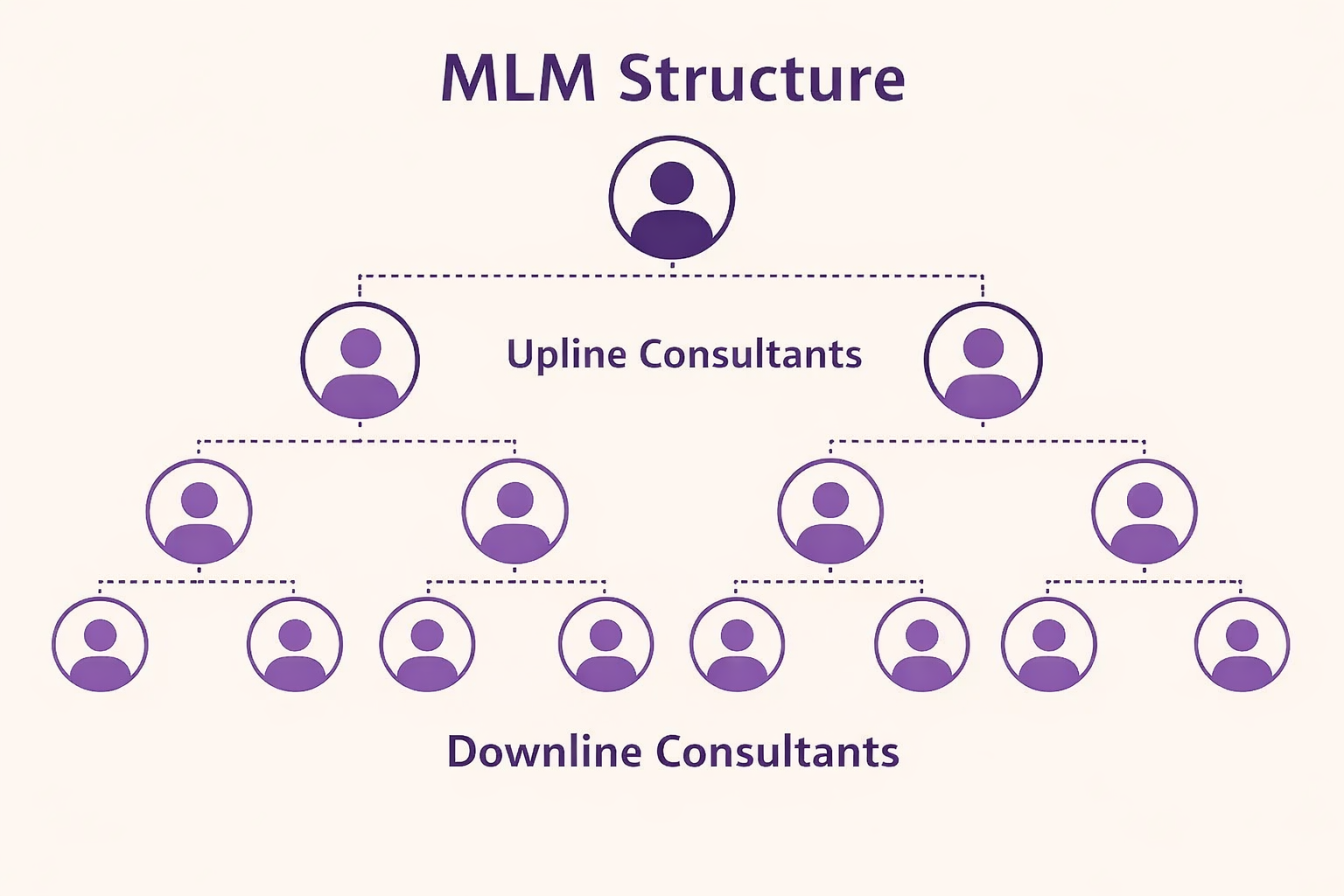
Uplines earn a percentage of their downline’s sales and exercise operational control over how their downline’s work, sell, and participate in the business.
Distributors Often Pay for the “Privilege” to Work
The harm caused by MLMs extends far beyond lost wages — it is systemic, compounding, and often life-altering. One of the most consistent features across MLMs is the requirement that workers pay to participate. Companies often impose up front buy-in fees just to begin selling, followed by mandatory recurring inventory purchases regardless of actual customer demand. Distributors are pressured to stockpile products at home with no realistic resale market, while also being required to attend meetings, so-called “training” sessions, functions, and conferences that often cost hundreds of dollars per person. In addition participants are commonly forced to pay for proprietary apps, software, and communication tools simply to remain active in the business. In some cases, uplines earn a cut from the very expenses they require their downlines to incur, including ticket sales, lodging, and event concessions, without disclosing that they are profiting off of their downlines.
In addition, despite labeling participants as independent contractors, MLMs simultaneously exercise extensive control over nearly every aspect of their work, and often their personal lives. Companies impose strict rules governing where and how products may be sold, mandate the use of company-approved marketing language, imagery, and platforms, prohibit sales through brick-and-mortar stores, personal websites, or third-party marketplaces, and retain the authority to discipline or terminate distributors at their sole discretion. Distributors are also required to attend meetings and training at their own expense, and sometimes even pay to attend, while the uplines require constant daily check-ins, participation, and attendance at weekly events. All of these factors are hallmarks of an employment relationship, not independent contracting.
Perhaps most telling, distributors’ customer networks are often treated as proprietary company property. If a participant leaves or is terminated, they lose access to the very network they built. This is not an independent business or entrepreneurship; it is economic dependence, and it repeatedly supports claims of employee misclassification under many state labor laws.
On top of this financial and legal harm is a powerful system of social and psychological control. New recruits are often “love-bombed” with praise and attention, only to find their relationships increasingly monitored and manipulated. Participants report pressure over who they may associate with (e.g., no “crosslining”), or even date. Those who question the model or attempt to leave are labeled lazy, unserious, quitters, and ostracized. They’re removed from group chats, shunned from social circles, and banned from community networks they were promised would last a lifetime. For many, exiting an MLM means losing not only income, but communities and friendships as well.
.png)
Holding MLM’s Accountable Through Private Litigation
Backed by substantial resources and experienced legal teams, MLM companies have historically discouraged individual plaintiffs from bringing labor and consumer law claims by imposing ironclad arbitration clauses that favor defendants and force disputes into confidential arbitration.
Through class actions, representative lawsuits, and mass arbitrations, however, the plaintiffs’ bar can hold MLMs accountable for misconduct against their independent distributors and consumers.
Two recent cases demonstrate the impact:
Yeomans v. World Financial Group
In October 2025, World Financial Group, an insurance-based MLM (“WFG”), agreed to a $65 million settlement resolving PAGA claims tied to worker misclassification, alongside allegations that the company operated as an illegal pyramid scheme. The size and recency of this resolution highlights that both courts and defendants are taking these claims seriously, and that high-value settlements in the MLM space are very much a present reality.
Dann v. The Rodan & Fields Company, et al.
Rodan & Fields, a skincare MLM, has agreed to pay a $8 million settlement for misclassifying their consultants as independent contractors and various California wage-and-hour laws, including claims for unpaid wages, unreimbursed business expenses, and penalties under the California Private Attorneys General Act (PAGA).
This case represents a significant victory for independent contractor distributors in the MLM industry. As a result of the litigation, the company fundamentally altered its business model in 2024, discontinuing the recruitment of new consultants into the business. Notably, this structural shift was not court-mandated; it was driven by the economic pressure of the litigation itself.
These cases are just two examples of litigation in a much broader enforcement landscape. Many actions against MLMs never make headlines, resolving instead through arbitration, mass arbitration, or confidential settlements that keep the full scope of misconduct out of public view. The relative scarcity of reported decisions does not reflect a lack of enforcement, it reflects how frequently these cases are resolved privately before ever reaching the courts. For plaintiffs’ attorneys this points to substantial, underexploited opportunity: widespread and repeatable violations, a large affected workforce, and an increasing number of defendants willing to pay — and, in some cases, change their business models — when faced with sustained legal pressure.
Recognizing MLM Structures and the Patterns That Drive Liability
One of the most striking aspects of MLM litigation is how consistent the violations are across companies. The same red flags appear again and again: upline/downline hierarchies, mandatory purchases and recurring fees, high levels of control paired with independent contractor classification, proprietary ownership of distributor networks, and pervasive lifestyle and earnings misrepresentations. These are not anomalies or isolated bad actors, they are features of the MLM business model itself. Once a company is identified as operating under this structure, the likelihood of systemic legal violations is high.
For plaintiffs’ attorneys, this consistency makes MLMs particularly well-suited to systematic investigation, portfolio-based litigation strategies, and data-driven case development. As recent litigation demonstrates, sustained legal pressure can force companies to abandon core elements of their exploitative models. Few areas of labor and employment law offer such a clear alignment between scale of harm, repeatable liability, and the opportunity to drive meaningful change, making accurate identification of MLM structures a critical first step in pursuing cases that matter.
This Might Interest You:
